Showing posts with label David Conn. Show all posts

Tuesday, April 03, 2012

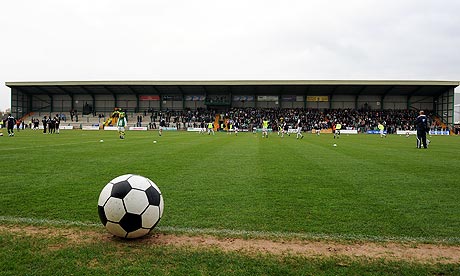
Northwich Victoria now consigned to sleeping on neighbours' floors

The Victoria Stadium was
perceived to be the answer
to Northwich Victoria's
problems – now it has
become a problem with
no ready answer.
Photograph: Clint Hughes/
PA Archive/Press
Association Ima

 Source: The Guardian

 After selling the Drill Field, their much-loved home for 127 years, it has been downhill all the way for the now almost destitute Vics

From mid-Cheshire, home to historic football clubs and chemical-industry giants, comes a tale of heartbreak and wandering, with just a glimmer of far-off redemption. For 127 years the evocatively named Northwich Victoria owned, played at and were justly famous for one of the world's oldest football grounds, the fabled Drill Field, yet now Vics, of all clubs, find themselves homeless.

The club have been evicted by a neighbouring chemical company, Thor, bringing a cruel full-stop to a decade of calamity. In 2002, previous Vics directors sold their greatest, defining asset, the Drill Field, for housing, and for ambition to build a new stadium on an industrial estate. Had the world been different the Drill Field would have been protected, for Northwich and future football generations, but the Conference, itself pumped up with professional ambitions, was insisting all its member clubs have 6,000 ground capacities, able to be enlarged to 10,000.

Near-tragically, as it turned out, the Conference reduced that rule to a more reasonable 4,000-capacity requirement just after Vics made their decision, so it could have been saved, but the directors decided to plough on anyway.

Formed in 1874, founder members of the Football League Second Division in 1892 when Billy Meredith, later of Manchester City and United, turned out for them, senior non-league competitors throughout the 20th century, Northwich Victoria sold the Drill Field to Bryant Homes, which dug it up and demolished it for 102 new houses.

The old board began to build the Victoria Stadium on the Wincham business park at the edge of town, with the hope that the bar and restaurant which they planned would make them money to climb the football ladder. Northwich, the town, club and fans, always seemed a non-league stalwart, not an out-of-town bar-and-restaurant sort of place, and the move was blighted from the start.

In early 2004 the money from selling the Drill Field proved not to be enough to complete the new stadium, and the club collapsed into administration. A Manchester nightclub owner, Mike Connett, bought the Vics and the new ground from the administrator, and oversaw its completion, with the bar and restaurant.

For a time it seemed as if Northwich's directors' vision of a better future could be realised at Victoria Stadium; in their first season, 2006-07, the team won promotion to the Conference Premier and reached an FA Cup third-round tie at Sunderland's Stadium of Light. But the financial hangover hit the following October and with the club at risk of falling into administration again, Connett kept the ground, and sold the club to a Manchester go-cart-track owner and property investor, Jim Rushe.

Rushe, still Vics' owner now, sank £325,000 in to pay wages and running costs, as did his then partner, Nick Bone, but it was insufficient to bail out the club and by May 2009 Her Majesty's Revenue and Customs had issued a winding-up petition for £433,902 unpaid taxes. Rushe took the club into administration again, and bought it back himself. "It was my dream to own a football club with a workable model," Rushe explains. "I knew what I was doing, and I still believe it is workable."

Connett, too, was having difficulties. In October 2008 Deloitte was appointed as receiver of the stadium by Clydesdale Bank, which had lent money to Connett, and the bank repossessed Vics' new ground. January 2009 was one of the grimmest periods in Northwich Victoria's long history, as they were forced to wander for the first time since they arrived at the Drill Field in 1875. Ultimately they returned to play their games at Victoria Stadium, but only on a short-term licence from the receiver, which was looking to sell it.

Rushe formed a new company and tried to borrow the money to buy the ground but due to the credit crunch, he says, no bank would lend to a venture whose anchor tenant was a non-league football club. The Conference insists that clubs emerging from administration pay all their debts and in 2010, despite another storming FA Cup run, in which Vics beat Charlton Athletic live on ITV in the first round, the club were expelled and relegated to the Evo-Stik Northern Premier League.

Rushe says he had paid a deposit in another serious effort to buy the ground, but could not secure the funding again. Finally Thor Specialities which, the company's managing director David Hewitt says, makes preservatives for a range of water-based products including flame retardants and hairspray, bought the ground for £598,000.

"We are a sustainable manufacturing company employing 85 people, and we bought the site to build a distribution centre and develop our own expanding business, which will create further jobs," Hewitt explains. "We have not forced the club to move; we bought the site with vacant possession."

When the receiver served the club with the eviction notice in January, Daniel Butters of Deloitte said it was repossessing the ground with "some regret". Owners of a special, atmospheric football home from 1875 until only 10 years ago, Vics are now doing the football club equivalent of sleeping on neighbours' floors. Mostly they have played their matches at Nantwich, but also at Macclesfield and Kidsgrove. Rushe has just announced a ground-sharing agreement for next season with Stafford Rangers, 40 miles away, which is filling no fans' hearts with glee.

Andrew Simpson, sports editor of the Northwich Guardian, which has chronicled all of this, roots the difficulties back to the sale of the Drill Field: "The club and the town lost one of its prime assets, somewhere everybody seemed to know, which put the town on the map."

On the field in the Northern Premier, the Vics have been doing remarkably well, under the management of the former Port Vale and Oxford United striker Martin Foyle and Aston Villa full-back Alan Wright, comfortably in the play-off places behind the leader, the supporter-owned and revived Chester FC.

Off it, groundless, Rushe says he will not be able to fund the club with their current wage bill next season, although he insists the club will stay in business. "With no stadium and no income streams, it is very hard to sustain," Rushe says. "I'm trying very hard, on a week-to-week basis."

In all this wreckage, there are chinks of cheer. Hewitt, of Thor, says he will donate the Dane Bank stand, floodlights and other movables to the club if they, and a new site, can be proven sustainable. The supporters trust, working with Supporters Direct, is actively seeking a "community-owned" future for the club. Sport England has a statutory right to object in any planning application if a sports site is disappearing with no new one to replace it, so a solution may need to be found before Thor can develop.

It is, then, possible to foresee a decent future for a venerable old club, somewhere over a mountain of toil. Yet it makes you want to bang your head against the locked gates of Victoria Stadium, and the house fronts on the old, great, gone Drill Field, at the needlessness of it all.

Community shares option

Northwich Victoria Supporters Trust are exploring a possible community share issue as a means of raising money to buy a stake in their stricken club. At an open meeting last week, the trust referred to similar offers, in which money has been invested by supporters and the wider community, at supporter-owned clubs FC United of Manchester and Wrexham.

The community share offer, developed by Supporters Direct, invites investment from supporters on a mutual and long-term basis primarily to help a club become sustainable. Investors agree not to seek withdrawal of their money before a specified number of years, and postpone interest until the club makes a profit and the directors decide it is prudent. FC United of Manchester, the club formed in 2005 by Manchester United fans opposed to the takeover by the Glazer family, recently raised £1.6m via community shares, towards the planned building of a new stadium in Moston, north Manchester.

Wednesday, April 21, 2010

FC United homage to history as they prepare for future at Newton Heath


The Guardian Sport 21 Apr 2010

Source: The Guardian

The club, formed in protest at the Glazers' leveraged buy-out of Manchester United, are to build their own ground

While Manchester United supporters were deliriously celebrating Paul Scholes's vintage winner at Eastlands on Saturday some 500 followers of FC United, the club formed in 2005 by fans opposed to the Glazer family's takeover, were singing with customary passion throughout their own fixture – a 4-1 defeat at Boston United.

Such have been the lives of contrasts since the Glazers arrived and loaded United with all that debt, now standing at more than £700m. "Big" United have nevertheless won three Premier League titles and the European Cup, while FC United have grafted through three promotions in the northern non‑leagues, to this challenging season in the Unibond Premier Division.

At Old Trafford, the Manchester United Supporters Trust's (MUST) remarkable green and gold campaign has flowered, an expression of yearning for the founding values of Newton Heath, the original United club, rather than the financial speculation of the Glazers. Now FC United have revealed that they too are planning their own homage to that history, announcing an agreement with Manchester City Council to lease land for a new 5,000 capacity stadium – in Newton Heath.

The site, the Ten Acres Sports Complex, in need of refurbishment in the deprived east Manchester district, is close to where Newton Heath, formed by working men on the Lancashire and Yorkshire Railway in 1878, played their early, pre-United football in green and gold. Close by, on the other side of the former brickworks, is a small housing estate, its streets named after the Busby Babes who died in the 1958 Munich air crash, including Roger Byrne Close, Duncan Edwards Court, Eddie Colman Close.

"The site is close to Manchester city centre, which is vital to us," explains Andy Walsh, FC United's general manager, "but the historic and emotional tie is important, too. FC United is a different, alternative club for United fans, and we want to be true to the original Newton Heath heritage, part of the community and accessible to the ordinary working people of Manchester."

For a supporter-owned club whose banners at the current home ground, Bury's Gigg Lane, proclaim "punk football", the stadium plans have been meticulously professional. Working with lawyers, planners and accountants, many giving their time for free, FC have produced proposals for a stadium costing £3.5m, a project which will refurbish the sports centre and provide facilities for extensive use by residents living around the ground. The council has agreed a grant in principle, and FC have also applied for funding from the Football Foundation. They aim to raise the rest by issuing community shares to supporters, which will not provide a financial return and be non-voting, so as not to disturb the club's cherished one-member-one-vote democracy.

"The prospectus is being finalised at the moment," says Walsh, the former firebrand opponent of United's plc status, and the Glazer takeover, trying not to smile at his authorship of a share issue. FC United are growing up, developing a club embodying the values the fans felt were being sucked away at Old Trafford, keeping tickets affordable for the average 2,000 regulars, and becoming deeply engaged in community work. The stadium plan will be accompanied with an "asset lock", a legal agreement that the ground will not be separated from the club in the future and sold off.

A reminder of how important such protection is, and the roots of the movement for supporter ownership, arrived last week when Wrexham's former chairman, Mark Guterman, was disqualified from acting as a company director for seven years. For the purpose of agreeing to the disqualification, Guterman did not dispute that in 2002 he "exploited" Wrexham's "property assets" – the club's tenancy at the Racecourse Ground.

The freehold was transferred to a company owned by Guterman's partner, Alex Hamilton, – who is contesting the disqualification proceedings – and the club's lease changed to allow them to be evicted on 12 months' notice. Guterman did not dispute that the "the primary purpose" of the scheme was "for my own personal benefit and that of my business associate, rather than for the benefit of the [club]".

The modern idea for supporter-owned clubs, in fact a reclaiming of most clubs' original status, was born at the Butchers Arms in Northampton in 1992 when Brian Lomax, a Liberal party member and Town fan, was bemoaning the running of the club. Lomax's notion, that supporters should own shares and have a say in the club, led to him and fellow fans forming a democratic trust. That idea impressed the Labour Government's Football Task Force, and led to the establishment in 2000 of Supporters Direct, with Lomax as the managing director, to help fans establish trusts more widely.

They have now been formed at more than 150 clubs in England, Wales and Scotland, and this season, due largely to MUST's green and gold campaign, and this season supporter ownership has become an ideal understood by the mainstream mass of fans. The facts are known more widely than ever before; the football public are aware that Barcelona and Bayern Munich are owned, respectively, by 100% and more than 50% of their supporters. Remarkably, the Labour and Conservative parties' election manifestos both carry plans to extend supporter ownership in Britain.

The efforts being finalised by the "Red Knights" to mount a bid to buy United from the Glazers represent the journey's most significant outpost yet – a selection of multimillionaires preparing to agree that a football club is not for financial exploitation, but should be owned without delivering a large return, with supporters enabled to buy a growing stake. Led by the Goldman Sachs chief economist Jim O'Neill, the Red Knights are understood to be ensuring all the investors are committed to that ethos, before they sign up.

Yet the Red Knights' plans also illustrate the basic stumbling block supporters trusts have met in seeking to establish themselves in the past decade: access to cash. Several have heroically rescued much smaller clubs, including York City and Chesterfield, out of catastrophe, then been forced by financial pressures to hand them over to businessmen. Exeter City are the only Football League club currently still wholly owned by their fans, while significant stakes are held at Lincoln City and Swansea. The handing over of Notts County by its trust to the mirage of Munto Finance stands, though, as an object lesson of what not to do.

If the political parties are genuine about extending fan ownership and representation in clubs valued at many millions, they will have to flesh out detail of how, practically, it can be done. In the age of billionaire owners, ordinary fans, however committed to the mutual ideal, have struggled to find resources.

In the meantime FC United are showing what can be achieved when starting from the beginning, with loyalty, defiance, and a backbone of work.

Wednesday, October 14, 2009

Supporters Direct keeps the faith in fan ownership despite setbacks

Source: The Guardian (David Conn)

Football economics make running a club via a supporters' trust a tough proposition but the ideal is being championed at a conference this week

Wimbledon

AFC Wimbledon supporters founded the club from scratch following a relocation to Milton Keynes, and the Conference Premier club is now a leading example of trust ownership. Photograph: Oliver Greenwood/Action Images

This has not, on the face of it, been the best 12 months for the enlightened idea that football clubs should belong to their supporters, rather than be prizes in a global tombola for millionaires. True, Barcelona, the most inspirational of member-owned clubs, won the Champions League in Rome with Unicef on their shirts, beating the Glazer family's AIG-sponsored, debt-leveraged Manchester United. But closer to home there have been sundry struggles.

Supporters' trusts, some of them newly formed, became the saviours of last resort for several stricken clubs around the 2002 collapse of ITV Digital, but the battle to compete financially, against clubs subsidised by wealthy backers, has seen several cede ownership back to single businessmen.

Notts County's supporters' trust voted by 93% in July to give away its majority stake in the world's oldest professional club to the Qadbak investment fund, whose backers have still not been identified. Stockport County, supporter-owned since 2005, overspent either side of their 2008 promotion to League One and went into administration in April. Brentford, whose trust took over a club owing around £2m in loans to the previous owner, old-school Ron Noades, did a deal with Matthew Benham, a Bees fan and professional gambler, which will see Benham invest £5m over five years then have the right to own the club outright.

Chesterfield and York City were also previously owned by supporters' trusts, which saved their clubs from extinction in hideous crises, but then found they lacked the wherewithal to enable the clubs to flourish, and passed them on to local businessmen.

Brentford aside, just one supporter-owned Football League club now remains: the defiantly cheerful Exeter City. Six years and two promotions since financial convulsions led to the club entering administration and being relegated to the Conference, and to the conviction of two former directors for fraudulent trading, the current period is close to the best the Grecians have ever had, according to the trust board member David Treharne. "There is a real feeling among our fans that as the club was nearly driven to the wall before, they are not willing to let that happen again," he affirms.

In the Premier League, where even a club such as Birmingham City has just been bought for £81.5m, owning the clubs has been beyond the reach of fans' mutuals; yet with eyes cast enviously on the Camp Nou, and the Bundesliga, where most clubs are more than 50% owned by fans, the idea has taken stubborn root among a corps of supporters. ShareLiverpoolfc registered nearly 10,000 members prepared to subscribe for a scheme to buy a stake of the Anfield club from the debt-laden Tom Hicks and George Gillett.

The Manchester United Supporters' Trust, fierce opponents of the Glazers' leveraged buyout which has saddled the club with £700m of debt, has amassed a staggering 36,500 members, committed to what MUST describes as: "The added affinity between the supporter and the club that only comes with supporter ownership."

The Arsenal Supporters' Trust, smaller, with 900 members, has accepted that owning the club is realistically beyond its potential, and like many trusts seeks to be a conduit for fans' views. Arsenal's trust lobbied influentially throughout their club's boardroom turmoil, for "custodianship" at Arsenal and against ownership by a single person, whether Stan Kroenke or Alisher Usmanov.

Supporters Direct, the initiative set up in 2000 by the government to promote fan involvement in clubs, is not trudging sheepishly to its annual conference on Friday, but pledging to learn the lessons of a difficult period. Despite recent difficulties, the organisation can point to trusts having formed at more than 150 clubs at all levels in England, Wales and Scotland, with 120,000 members in total, and £20m raised and invested across the clubs. That stands as a remarkable record of progress for an idea which, 10 years ago, was still obscure, the brainchild of Brian Lomax, founder member of a supporters' trust at Northampton Town, who steps down this year as Supporters Direct's chairman.

"We are not reacting to recent events at Notts County or Stockport believing they have delivered a blow to the trust idea," Dave Boyle, the organisation's chief executive, emphasises. "We believe very firmly that football clubs are community, sporting institutions, not private businesses, and that principle has gained tremendous support over the last decade."

It has also been backed by Uefa, which has enshrined in its strategic documents the conviction that supporter ownership is the ideal model for football clubs, and funded Supporters Direct to extend its work to fans in other countries. "Uefa recognises the growth of supporters' trusts in Great Britain as very progressive," says Gianni Infantino, Uefa's new general secretary. "It is a good model for football clubs – membership clubs which exist for their supporters – and we believe they can also help achieve the objective of financial fair play, where clubs do not make repeated losses every year."

That has been the difficulty in practice here for the mutual model, that whatever the money accumulated by the fundraising commitment of fans, it is swamped by the millions made available from wealthy backers, at all levels.

"The supporters' trust is a great model for a football club because its members are committed to the club being there for the long term, and they attract volunteers prepared to give their time for free," explains David Merritt, chairman of the Bees United supporters' trust and a Brentford director. "However, they cannot change the fundamental economics of football, in which so many clubs operate at an unsustainable level, increasing their levels of debt every year. That has to be reformed, to protect all clubs."

It is significant that three standard bearers of the trust "movement" which have flourished, FC United of Manchester, and AFCs Wimbledon and Telford, were started as collective endeavours by the supporters from scratch, not, like most of the league clubs, saddled with the debts of a failed previous regime.

Telford, previously in the Conference, were one of the few financially stricken clubs to go into liquidation, and fans set up their own to take its place. AFC Wimbledon, promoted to the Conference Premier last season, were founded at the base of football's pyramid by the vast majority of dons who refused to go to Milton Keynes with the husk of the old Wimbledon. FC United of Manchester, the do-it-yourself club formed by fans finally alienated from Old Trafford by the Glazer takeover, are regularly attracting around 2,000 supporters, huge in the UniBond Premier League.

"We look at what those clubs have achieved, and Exeter, and it shows what trust-owned clubs can do," Boyle says. "The last six months have reminded us how difficult it is for supporter-owned clubs financially in the Football League, so while we keep pressing for wider reforms to football, we need to consider the further help we can give to trusts, which are all run by volunteers."

From small beginnings, supporter involvement in clubs has struck a major chord, and been endorsed at the highest level of European football. It has just been fiendishly difficult for mutual ownership to work in professional football's mucky reality and murderous economics.

Supporters Direct's annual conference takes place at the NEC, Birmingham, this Friday. www.supporters-direct.org
Supporter Ownership

British professional football clubs mostly began as mutual, membership clubs, then converted to limited companies, with shares to buy and sell, in the late 19th century. Supporters Direct was launched to promote democratic representation of supporters in clubs in January 2000, backed by the government, with cross-party support.

German Bundesliga clubs have to be more than 50% owned by their supporters, with the exceptions of Wolfsburg and Bayer Leverkusen, which are companies. Fans of German clubs have campaigned hard to keep that rule, to prevent the over-commercialisation of their clubs, against some club directors who want it abolished.

In Spain, Barcelona, Real Madrid, Athletic Bilbao and Osasuna are owned by fans and hold elections for their president and board.

Wednesday, May 09, 2007

FC United rise and shine on a sense of community


Source: The Guardian

While Manchester United have been slaying the Premiership, rebel offshoot FC United have been setting their own records.
David Conn
May 9, 2007 12:24 AM

FC United of Manchester, formed by fans opposed to Malcolm Glazer's takeover at Old Trafford, have travelled a joyfully long way from mere rebellion. At Gigg Lane, a week before "Big" United were confirmed as Premiership champions, FC fans stood and sang throughout a 5-0 demolition of Formby, completing their own second season of record-breaking, championship-winning promotion.

In gorgeous weather surely never previously witnessed in April in Bury, in the raucous section of the Main Stand and the packed Manchester Road End, the fans belted out Sloop John B, customised as their season's anthem: "I wanna go home/I wanna go ho-o-ome/This is the worst trip/I've ever been on."

There is a depth to this commitment which quite unexpectedly caught me by the throat, got me in the eyes. FC United may have started in protest at the heart-sinking economics which devoured Manchester United but it is powered by the fans' heartfelt attachment to football and the collective belonging they feel it represents. The relationship with "Big" United is complex; most FC fans still support the club - packing the pubs and Gigg Lane social club to roar United on to the 4-2 win at Everton before FC's game last week - but they grew alienated, over time, from the business which is Manchester United.

Mike Turton, 44, an electricians' supervisor, who was at the Formby match with his daughter Danielle and sons, Ryan and Thomas, is a typical FC founding father. An Old Trafford regular for 31 years, he packed in on May 12 2005 - they can all recite the date - when the Glazers, from their Florida base, finally acquired United with their £810m hedge fund-leveraged deal.

"I didn't leave because of the takeover," he said. "That was just the final push I needed to get out. It started in the Nineties; winning trophies was very nice but I didn't support United to win trophies. I'd stopped enjoying it. The prices were rising and I started wondering why I was forking out to fund the players' ridiculous wages.

"I love what we've built here, I'm really proud of it. I like to think it's in the best Manchester tradition of protest, along the lines of the suffragettes and the Trades Union movement, which have their roots here."

You hear this Manc pride a lot as well as bemusement that fans of other clubs have not protested against their takeovers - "Not even Liverpool," the FC fans all murmur. Here they have moved on, to building their own club according to the principles they argued for when campaigning: supporter-ownership, with members (2,500 of them) voting for the board and policies; ticket prices affordable at £7 for adults, £2 for under...#8209;16s, and an agreement with stewards that supporters can stand. The club has established a youth policy which seeks to work with junior clubs who often feel exploited by the way professional clubs' academies trawl for the best players. FCUM have also made partnerships with social welfare and community organisations, seeking to welcome marginalised groups and introduce football as a good presence in their lives.

Andy Walsh, the former Militant firebrand and leader of the United fans' anti...#8209;Murdoch and anti-Glazer campaigns, has been reinvented here into FC United's general manager, all trim in a blue check suit and club tie, directing details on his walkie-talkie - stewards, tickets, match day volunteers.

"Most people here still love United," Walsh said, "but they love their feeling for United, which grew from following the club for years, not the big business which came to exploit that loyalty. We're aiming to show a football club can be run by and for supporters, open to all sections of society."

The Formby match was designated a youth day, with under-16s allowed in free and young people before the game taking part in drama, banner-making and working with the Touch of Class rap collective, which promotes an anti-gun message. Thomas Cullen, a coach at Trafford Athletic Club, brought a group; he said he believed one lad had just been saved from being excluded by his school. "His teacher is here and she saw a different side of him," he said. "This is great for them. They're mostly black lads from Hulme and Moss Side but not one has ever been to a match at Old Trafford because they can't afford it."

Bill Evans, manager of Rochdale Children's Rights and Advocacy Services, brought 30 children, all in local authority care, saying it was a "positive way for them to feel included". Maxine Seager of the Tameside Youth Service, a disaffected "Big" United fan herself, came with 70 kids - "Two coach loads," she said, grinning and rolling her eyes.

"They're loving it, buzzing. They get so much out of this and we work our programmes, on anti-racism and social cohesion, around coming to the game."

The youth day events were organised by Vinny Thompson, who seemed staggered by his own football conversion: "To go from parading on terraces all over Europe to being a lentil-eating social worker in two years is pretty bloody amazing."

The thirty- and fortysomething Stretford End veterans who formed FC United are painfully aware that Premiership ticket hikes have largely priced out the next generation of fans, so are replenishing their own ranks with the regular £2 entry price and this youth day. The place was teeming with kids, a sight long disappeared from top-flight football. One group of eight, aged 11 to 14, marching along with classic red, white and black scarves around their necks and not an adult in sight, seemed like a Life On Mars throwback to the 1970s. One eloquently explained why they come: "The atmosphere's mint."

The 3,847 who made it to the Formby game may not represent the dent in the Glazers' business plan some hoped for but it is many more than Bury had at their last home game, a phenomenon at the base of football's pyramid. The five goals strolled in took FC's total this season to 157 and a finish on 112 points; both are records. After the game the North West Counties League title was presented to Dave Chadwick, FC's mountainous captain, Walsh discreetly handing out the champagne. Beaming, bowing to shake hands with crowds of kids at the Manchester Road End, the players looked disbelieving, that tough semi-pro careers have turned out this glorious.

Karl Marginson, the former Rother-ham United and non-league striker who has proved the perfect manager, said he has understood FC's philosophy more with time. "It's a very special thing to be part of. I try to instil its importance in the players, that this is the fans' club."

In the celebrating stands they were mixing fond player ditties, anti-Glazer chants and pro-FC compositions. To the tune of Anarchy in the UK they roared: "I am an FC fan/I am Mancunian."

This is a football club they have fashioned for themselves out of belief and conviction. While Big United chase the Double at Wembley, they are off to the UniBond Northern Premier League next season. It seems like the best trip they have ever been on.

Manchester's proud tradition of protest

Peterloo

The army's slaughter of 11 people attending a mass rally for parliamentary reform in 1819 accelerated popular pressure for democracy

Marx and Engels


Karl Marx's political ally, Friedrich Engels, lived in Manchester and based his 1844 classic, The Condition of the Working Class in England, on the city's inequalities

Trades Union Congress

Formed in 1868 at the Mechanics Institute in Manchester

Suffragettes

The Women's Social and Political Union, that lobbied for the vote, was formed by Emmeline Pankhurst at her home in Manchester in 1903

Right to roam

The campaign for access to the countryside was boosted by the 1932 Kinder Trespass, led by the Manchester activist Benny Rothman

Punk rock

A Sex Pistols gig at the Lesser Free Trade Hall in 1976 is often heralded as the birth of punk and inspired a generation of Manchester music

FC United of Manchester

Formed in 2005 by Manchester United fans protesting at the Glazer takeover