Showing posts with label The Observer. Show all posts

Sunday, May 13, 2012

Manchester divided: United and City fans on football's power shift

 Edited from The Observer

 With City favourites to claim the Premier League title, the city's football fans are adapting to a world turned upside down

...
There is a football sage in Manchester, Adam Brown: a former United fan but now board member of FC United of Manchester, the non-league club that emerged from dissent against the commercialisation of the game in general and at the Glazer takeover of United in particular.

Brown, who has not watched United since 2005, now runs an independent social research co-operative called Substance, but in 2002, for Manchester Metropolitan University, compiled the only statistical data on each team's geographical base, finding that in 2001, United fans came mostly from the north and west of the city, and from Salford, City's from the east and south.

More season tickets at Old Trafford were sold to fans with Manchester postcodes than at Maine Road, but a higher proportion of those at City were locals. Gone were the days, says Brown, when fans used to watch both teams on alternate Saturdays. But "there are dichotomies within both clubs. United fans love the glory, but even in the late 90s a backlash against BSkyB's attempt to buy United led to a reassertion of local club identity.

Ed Vulliamy

Sunday, November 21, 2010

FC United: A punk football fairytale

 Source: The Observer

 Dismayed by the way the professional game is heading, a group of Manchester United fans set up their own club five years ago. They don't have a ground and their striker is a tiler on £80 a week, but already FC United is the focus of passionate local support. Here, an astonished fan charts their remarkable rise from small-fry idealists to FA Cup giant-killers


FC United: A punk football fairytale

Dismayed by the way the professional game is heading, a group of Manchester United fans set up their own club five years ago. They don't have a ground and their striker is a tiler on £80 a week, but already FC United is the focus of passionate local support. Here, an astonished fan charts their remarkable rise from small-fry idealists to FA Cup giant-killers

* Julian Coman
* The Observer, Sunday 21 November 2010

It was a sight Manchester has seen many times before. Hordes of fans wearing red, white and black scarves, piling off a late-night train at Victoria, after a November night fixture away from home. Triumphant chants reverberating around the station forecourt. Dancing football players in red pictured on the front page of the newspaper the next day. Not unfamiliar stuff in a city that sees itself as the "new Milan" of world football. But there was one crucial difference.

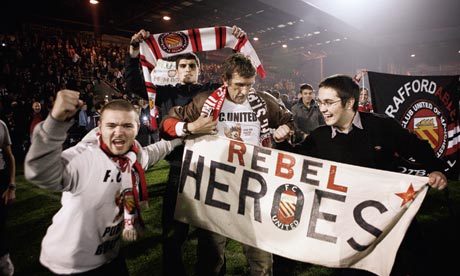
This time the headlines made no reference to the reds of Manchester United. Instead, they celebrated a fireworks- night insurgency by another United, FC United of Manchester – the team formed by a group of football activists in opposition to the debt-financed takeover of the Old Trafford club by the American Glazer family in 2005.

To the acclaim of the wider football world, the delight of ESPN – the satellite sports channel which chose to show the match live – and the outright astonishment of their own travelling army of supporters, on 5 November non-league FC beat Rochdale AFC – a team 95 places above them in the football league pyramid – 3-2 in the first round proper of the FA Cup.

It was their first competitive match against league opposition and their first match at this stage of the world's oldest football competition. The game was shown in China, Germany, Scandinavia and beyond. And on a rainy Lancashire night, victory was achieved in a manner that suggested that on Guy Fawkes night 2010, the fates had finally decided to take the side of the rebel: the winner was scored in injury-time by centre-forward Michael Norton, who may, possibly, have kicked the ball out of the goalkeeper's hands.

A tiler by trade, Norton earns £80 a week playing his football in a city where Sheikh Mansour of the United Arab Emirates has spent £355m buying Manchester City a new team. Where Wayne Rooney has just signed a contract worth £200,000 a week after threatening to leave Manchester United to join them. By contrast, the £100,000 earned by FC on 5 November is enough to pay the wages of FC's playing and coaching staff for an entire season.

"Glory Glory FC United" announced the Manchester Evening News. The fan-owned, members-run club, once described as a bunch of "attention-seekers" by Sir Alex Ferguson, the manager of Manchester United, had succeeded in grabbing the attention of the entire football community. When Zoo magazine publishes a double-page spread comparing Rooney with Carlos Roca, the diminutive FC winger who works by day as a debt adviser, a threshold has clearly been crossed.

I should, at this point, declare an interest. Five years ago I became a founder member of FC United of Manchester, after a lifetime supporting Manchester United. Like 4,000 others that summer, I joined out of a sense of outrage at the takeover of United by a Florida-based businessman who bought a footballing institution with debt he then piled on to the club. Since 2005, Manchester United, previously debt-free, has paid out hundreds of millions of pounds to service the debt of the Glazer family. Levels of investment in players have dropped markedly and ticket prices have gone up by around 50%. Last season, the green and gold protest campaign, sponsored by the Manchester United Shareholder's Trust (Must), prompted tens of thousands of United fans to wear the original colours of the Newton Heath club that was the forerunner to the modern Manchester United. "Green and gold until United are sold" went the slogan.

But this season, the Glazers are still here. Or rather over there, in the United States. The family cannot freely walk the streets of Manchester for fear of attack. Meanwhile, among those who chose to give up their Old Trafford season tickets, in some cases after decades of attendance at matches home and away, something remarkable has happened: a club formed out of a sense of revulsion at the Glazer takeover, and run on the basis of one member one vote, has become the focal point of a strangely wonderful, slightly bonkers, always passionate football community.

The rise of FC United of Manchester is another sign of times in which, to paraphrase the Annie Lennox/Aretha Franklin hit, sisters and brothers are beginning to do it for themselves. In music, the pioneering American rock band Nine Inch Nails, after becoming exasperated with the corporate side of the business, cut out the executives altogether. Across Europe, workers' co-operatives of all kinds are booming. In Britain, new technologies have allowed a boom in self-publishing. Last month, the Portobello film festival in London celebrated good-quality DIY filmmaking done on the cheap.

At members-owned FC United, which won the UK's Cooperative Excellence Award in 2009, they call it "punk football" – "Our Club, our Rules". The famous Sex Pistols appearance at Manchester's Lesser Free Trade Hall in 1976, was voted one of the most influential gigs of all time. Rochdale might just have been a punk breakthrough on the football pitch.

On the fifth floor of a former mill in Ancoats, deep in what was once the industrial heart of Manchester, FC's 31-year-old club secretary Lindsey Robertson is dealing with the Monday morning aftermath of the Friday night before. Specifically, she is attempting to locate the owners of four lost pairs of keys. "Rochdale contacted us today," she explains. "They found four sets on the stand where the FC fans were." Given the bouncing atmosphere at Rochdale – former Celtic player Craig Burley told ESPN it was the best he'd experienced in years – it comes as no surprise that some people lost the contents of their pockets. After the match, when the FC forward, Jerome Wright, was asked by Norwegian television reporters what he thought of the club's fans, he turned the cameras on to a mass of jubilant teenagers and gave them the microphone, saying: "Give them a song." The implication was: "This lot can speak for themselves."

Or sing for themselves. Liberated from the stifling constraints of all-seater stadiums where groups of friends can rarely watch the match together – assuming they can afford to get in – FC fans have collectively found an anarchic joie de vivre that has inspired a succession of YouTube hits.

Their songs mix the defiant, the surreal and the simply comic. Some are Manchester United classics, sung to reaffirm a connection that for 99% of FC fans will never go away. Others are new, conceived by a hardcore of fans reared on the biggest matches in the biggest stadiums in Europe, and belted out at non-league grounds around northern England.

The Sex Pistols are reworked in "I Am an FC fan" to the tune of "Anarchy in the UK", in which a political manifesto is laid out at deafening volume: "I am an FC fan/I am Mancunian/I know what I want/And I know how to get it/I want to destroy Glazer and Sky/Cos I wanna be at FC".

In honour of new rivalries and one old one, the first season saw a lively reworking of a traditional supporter's favourite to the tune of "Land and Hope and Glory": "We hate Blackpool Mechanics/We hate Cheadle Town, too/We hate Manchester City/But United we love you." The club's first goalkeeper, the supermarket checkout worker Barrie George, was offered his own hymn of solidarity after his name attracted the crowd's attention: "Free Barrie George!/He wants the world to know/He didn't kill Dando!"

The Beach Boys ("Sloop John B") and the Carpenters have been adopted for cover versions, the latter taking off during a prestige friendly last season against the German fan-owned club St Pauli. For half an hour after that game – in the by-now deserted ground – the 300 or so fans perched in the highest section of a stand sang out the chorus: "I'm on top of the world, lookin' down on creation/And the only explanation I can find/Is the love that I've found, ever since you've been around/Your love's put me at the top of the world".

The mood created is quite intoxicatingly upbeat. A few days after the famous victory, Karl Marginson, the team coach, was still struggling to come down from the high. Marginson is a former player in the lower leagues who then became a fruit and veg delivery man ("We've got Margy with his fruit and veg van," sing the fans). "There is unbelievable positivity coming off those stands," he tells me. "At other clubs, people cheer when teams win and boo when they lose. FC fans don't boo. The atmosphere reminds me of how Old Trafford was when I used to go in the 1970s. It's got that sense of togetherness that there used to be when lads used to go and stand together on the terraces."

The sense of solidarity in the stands feeds into a commitment to the wider community. All of FC's players have visited schools around Manchester, training youngsters in the poorest areas of the city. Marginson in particular, say all associated with the club, "gets" the FC message. "Kids respond if you take the time to understand them a bit," he says. "I tell them to treat each other like they're in a dressing room. They need to look after each other and stick together."

The club's wiry grey-haired general manager, Andy Walsh, laughs at the mention of the songs: "It makes me laugh when people ask me, mystified, 'What's that Carpenters song all about?' I tell them: 'Think about it. It's a love song!' It's the spirit that comes from empowerment. The bedrock of this club is the constitution that gives each member one vote. And the most important thing about Friday night [against Rochdale in the FA Cup] is not the money, although that's certainly useful. It's the message that was given out on live television: that in football it's the ordinary fans and how they want things to be that matters more than anything else."

Walsh went to his first Manchester United match at the age of five in 1967. A former IT worker, he was pivotal in the successful campaign to stop Rupert Murdoch taking over Old Trafford in 1998. But in the late summer of 2005, after the Glazer takeover, he sat in his car outside Old Trafford for what seemed like an age, turning a letter over in his hands. "It was a request to withdraw my season ticket," he said. "Even after I posted it, I didn't know whether it felt right or not."

Discontent with the way United was being run had been growing for some time. In 1995 the Independent Manchester United Supporters Association (IMUSA) had been formed to represent fan's views in the wake of a Tannoy announcement during a crucial game ordering fans to sit down. It was an instruction that led to the immediate birth of the chant: "Stand up for the champions!" as the majority of spectators stood in protest. Stewarding became increasingly heavy-handed. The Stretford End, the famous former terrace and locus of United's most passionate supporters, was renamed the West Stand and its first tier filled with executive seats. A generation of fans felt that the whole experience of attending football matches was being transformed, and not for the better. For a younger generation, the escalating price of tickets meant that going to the match increasingly signified going to the nearest pub that carried games on Sky television. For the rebels, FC were to be the antidote to "modern" football (ticket prices today are £8 for adults, £5 for over-60s and £2 for under-18s).

According to Walsh, the late 1990s battle against Murdoch, which led to the BSkyB bid for United being blocked by then Labour minister Stephen Byers on competition grounds, provided the future founders of FC with an invaluable political education before the big leap into the unknown. By the time the Glazers took over, a significant cadre of United supporters, the majority involved in the club's influential fanzines, Red Issue and United We Stand, were ready for what was described as "the nuclear option" – the formation of a breakaway club. FC United was the provisional name. Rejected as too generic by the Northwest Counties league, which the new club was applying to join, the membership eventually settled on FC United of Manchester. A revolution conceived in FC's "Granita" moment – a Red Issue curry night in the Barbar restaurant in Rusholme – became a reality. In three years, backed by record-breaking crowds in excess of 2,000, FC achieved three successive promotions. From their vantage points in the raucous stands in Bury, FC fans "looked down on creation".

Five years on from year ZERO, not everyone wants to sing the Carpenters with FC. At the White Lion pub on Liverpool Road, the day after the FA Cup triumph, a packed pub was watching "Big United" struggle to overcome lowly Wolverhampton Wanderers in the Premier league. This was the pub chosen by Ken Loach for a scene in his film Looking for Eric, the story of a down-on-his-luck postman who forms an imaginary relationship with Eric Cantona, the undisputed hero of United's recent past. In the film, as a group of United fans gather to watch an important European midweek game on the pub screens, an argument breaks out between an FC fan and his mates, who accuse him of betraying the United cause. When he storms out of the pub, they cheer a nonexistent goal, leading their victim to dash back in, shouting: "Who scored?" to general laughter.

In real life, United – like FC the night before– grab an injury-time winner against Wolves. A group of men start directing jibes at FC. The general theme is: "There's only one United, right or wrong. You have nothing to do with United." Leaving after the match, a stocky man who says he has fought for United "all over Europe" and gone to jail abroad on their account, stops for a word. Earlier he told me that his son, a marine, follows the breakaway club. Now he says matter-of-factly: "I have to tell you that I will always consider you a bunch of traitors. You split us. And I will never be able to forgive you for that. That's the truth."

Such arguments have gone on since the inception of FC, across pubs and workplaces in Manchester, when friendships were broken and brief attempts were made by a small group of United diehards to stop fans going to Gigg Lane. But according to almost everyone I speak to, the tension now is much less than it used to be. On the Manchester United supporters' websites, the tales are legion of non-FC United fans who found themselves celebrating wildly when Norton's clinching goal put FC in the second round of the Cup. "There's a groundshift in opinion," says general manager Andy Walsh. "The recent 'Rooney saga' was a tipping point for many. And after the numerous ownership sagas, at Liverpool for instance, the club's ideas are gaining traction. After Rochdale, I got a message from a Red Issue stalwart who had not previously been supportive: 'You're idealists,' it said. 'But the people who established Newton Heath in 1878 had ideals. They didn't know where it was going to go. Hats off to you.'"

It is in Newton Heath, within view of the vast Eastlands stadium where Sheikh Mansour's multimillion-pound signings play in a different world, that FC fans hope the next phase in this football insurgency will take place. On 25 November, a few days before their second-round FA Cup tie, the club hope to be given the final go-ahead by Manchester City Council to build a 5,000-capacity stadium in an area that was a hub of the Industrial Revolution, but which now ranks among the most deprived inner-city areas in the country. At present the club pay a rent of £5,000 per match to play at Gigg Lane in Bury, a 30-minute tram ride from Manchester.

The proposed move is pregnant with footballing symbolism. The Newton Heath Lancashire and Yorkshire Railwaymen Football Club was formed here in 1878, moving across the city to Clayton in 1893 and renaming itself Manchester United in 1902. Untroubled by tourists, the streets of a modest council estate are named after the lost Busby Babes, the eight United greats who died in February 1958, when the team plane crashed on take-off at Munich airport. But after the songs, sentiment, colour, pride and energy of the past five years, this is where the revolution gets technical.

In negotiation with the council, the FC board of directors have agreed that through a "community share issue" (CSI) the club will raise £1.5m towards the cost of developing the crumbling Ten Acres Lane sports site, which currently boasts a dilapidated all-weather pitch and a modest sports centre. The CSI will allow fans and investors – who must become members – to buy a minimum of £200 of shares in the club and a maximum of £20,000. The money cannot be withdrawn for three years, after which it is hoped that an interest rate of 2% above the bank base rate will be paid on the investment.

An "asset lock" will ensure that the stadium and its facilities – including an artificial pitch, function rooms, a clubhouse bar and a regenerated sports centre – cannot be used for anything other than the benefit of the local community. In addition, the club have guaranteed to find £500,000 from their development fund, raised through donations collected by the 300 volunteers who keep it going. The fund total already stands at £300,000. If FC can raise the £1.5m, the council will play its part by offering a peppercorn rent and a lump sum to eventually be repaid with interest.

Nothing like this has ever been attempted by an English club. "The idea of FC United – its ideals and vision of community – needs a home," says Adam Brown, one of the club's founding board members. "We can be a catalyst here for other things to happen. We already do loads of work in communities, but it's important to have a base. What we hope is that ethical investors who like what we're doing will put the money in."

Call it punk football, DIY football or just old-fashioned community values, reasserted after a close encounter with a carpet bagger from Florida. Whatever it is, it's happening in Manchester. Inevitably there is already a song for the new ground, sung to the tune of Ewan McColl's "Dirty Old Town": "We'll build our ground at Ten Acres Lane/We'll lay the pitch by the old canal/We'll live the dream down in Newton Heath/We're gonna build our own ground/We're gonna build our own ground".

To find out more about the FCUM Community Share Scheme and to see plans for Ten Acres Lane, visit fc-utd.co.uk

Sunday, November 07, 2010

FC United's impossible dream goes on

Source: The Observer

* Julian Coman
* The Observer, Sunday 7 November 2010

Formed in rebellion against Old Trafford's millionaire owners, a football club owned and run by its fans tastes FA Cup triumph

When it comes to seeking inspiration for football terrace anthems, the 1970s melodies of the Carpenters are not an obvious option. But late into the evening on bonfire night in Rochdale, thousands of beery Mancunian voices were channelling sunny Californian optimism into the damp Lancashire air:

"I'm on the top of the world," they sang, "looking down on creation, and the only explanation I can find, is the love that I've found ever since you've been around. Your love's put me at the top of the world."

The song is the latest favourite of the supporters of FC United of Manchester, the rebel club formed five years ago in opposition to the debt-laden takeover of Manchester United by the American Glazer family. And this weekend the lyrics just about sum the situation up.

I became a founder member of FC United in the summer of 2005, but never expected to witness scenes such as those at Rochdale AFC's stadium on Friday night, when FC United won 3-2. A non-league club conceived by a few angry dreamers in a Manchester curry house reached the second round of the FA Cup, beating a team four leagues above it with a winning goal in the last minute of injury time.

Bedlam, hysteria, delirium: no word can do justice to the scenes that followed. Jerome Wright, the club's cult forward, was still being chaired half-naked around the pitch half an hour later.

For many of the 4,000 FC fans who were wiping their eyes or locked in embrace with total strangers, a big away game used to mean Milan or Barcelona, following Manchester United. They still sing the name of Eric Cantona, the French forward and United hero, who has gone on record to support their anti-Glazer stance.

But somehow, for many of them, Rochdale was bigger than Milan. One fan said before the game that he had not looked forward to a game so much since Manchester United played in the European Cup final in 1999.

There were tears, flares, flags and endlessly swirling green and gold retro scarves. And at the final whistle there was sheer incredulity at the fact that something no one in the 7,000-plus crowd thought could happen actually had happened. "That was simply unreal," said Adam Brown, a member of the board of directors.

It was a night that gave sublime, heady vindication to a rebellion without precedent in the history of football. At the time of FC's formation, in the bleak aftermath of the takeover, there was a recurring image that summed up the attitude of a protest movement that wanted to do more than just oppose.

Back then the archetypal FC rebel would listen politely to all the pundits, Premier League officials and financial experts, nodding dutifully when told that the new Glazer regime, high ticket prices and outlandish salaries for players were just "part of modern football".

Then he or she would say: "Sod that. We'll do it this way."

FC are fan-owned. Each of the members has a vote on all important matters. Tickets are kept inexpensive. A commitment to community work is written into the club's constitution.

Manchester city council has been so impressed with the activities organised by the club in some of the most deprived areas of the city that it is expected to grant FC a lease to build their own ground in Newton Heath – where what was to become Manchester United was founded by railway workers in 1878.

More than 300 of the club's members volunteer in vital tasks to help keep the costs down. If David Cameron wants a vision of the "big society" in action, he can find it at FC.

The players play not for the money, but for the adulation of some of the biggest crowds in non-league football. The club's star striker, Michael Norton – scorer of the winning goal on Friday night – earns £80 a week playing for FC, almost £200,000 a week less than Wayne Rooney.

One much-loved ex-player, Rob Nugent – a big Manchester United fan – has just been voted on to FC's board. In his introductory statement to members, he wrote: "I retired from playing football after qualifying as an accountant, but still want to be involved with a club that I have supported since the first meeting. I have already been assisting the board with the management accounts, and would like to use the skills I have gained professionally in this manner and show that there is another way for football clubs to be run."

All this passion has found joyous expression in a set of supporters who are perhaps the loudest, most colourful and irreverent in English football. The banners and flags on display at Rochdale – and every week at the club's current home in Bury – are a triumph of attitude and chutzpah. "MUFC – FCUM – I've got love enough for two" reads one, reflecting the fact that almost all FC fans remain attached to their first love, Manchester United.

"A Right Bunch of Dicks" states another, in happy acknowledgement that not everyone has welcomed the FC revolution. Certainly not the Manchester United manager, Sir Alex Ferguson, who once described the club's fans as "self-publicists".

The songs are upbeat and defiant, ranging from the Carpenters cover to an FC reworking of the Sex Pistols' lyric "I am an anarchist" ("I am an FC fan"). Another favourite, "He sells asparagus", celebrates manager Karl Marginson's past as a fruit 'n' veg delivery man.

Friday night's triumph at Rochdale, which was shown live on television, announced FC United of Manchester to the wider world. In that packed, rocking stand, where the level of support would not have disgraced the Nou Camp in Barcelona or the San Siro in Milan, it felt as if we were attending a political rally and a raucous religious service, as much as a football match.

The money from this scarcely believable cup run – ESPN paid FC £67,000 for the right to screen the Rochdale match – will go towards building the club's own ground. The publicity will build the profile of a club that is already taking on a special charisma of its own.

An extraordinary thing has happened. Out of the bitterness, division and recriminations that surrounded the debt-fuelled takeover of England's most charismatic football club by a Florida businessman, a new club has been born. Bring on the second round.

Sunday, February 28, 2010

Manchester United fans go green and gold at Wembley in colour-coded protest against owners

Source: The Observer


* Luke Bainbridge and Ed Vulliamy
* The Observer, Sunday 28 February 2010
* Article history

Angry supporters to use Carling Cup final at Wembley against Aston Villa to publicise bid to oust Glazer family

Wembley Stadium will reverberate this afternoon to the sounds of the first colour-coded football rebellion as Manchester United take on Aston Villa in the Carling Cup final and fans of the Premier League champions stage a vivid protest against the club's controversial American owners.

Instead of the usual bank of red and white, United's end of the stadium will be green and gold – with 30,000 coloured balloons sent skyward. Thousands of Manchester United fans will also be wearing green-and-gold scarves distributed by the Manchester United Supporters' Trust (Must). Must is campaigning for the removal of the American Glazer family, which bought the club in a debt-leveraged buyout in 2005. Intended as a symbolic rejection of the Glazer family's ownership, the green-and-gold theme harks back to Newton Heath, the club founded in 1878 that then became Manchester United in 1902.

Today's game, which is certain to attract a large international television audience, is seen as an opportunity for independent supporters' organisations to demonstrate the extent of opposition to the Glazer family's continued ownership of the club. The green-and-gold protest began at the beginning of the year, after the publication of club accounts for 2008/2009. The figures revealed that without the sale of Cristiano Ronaldo to Real Madrid for £81m, the colossal interest payments on the club's debt would have meant a net loss, after a hugely successful season in which the club won the Premier League and reached the Uefa Champions League final.

Referring to the green-and-gold protest, a spokesman for Must said yesterday: "We've done what we can, and we're hoping to see if during any celebrations, the players put on any green and gold – we'll be throwing things on to the pitch, scarves and stuff and whichever way they go, it could be interesting."

The Wembley protest comes after a week in which the issues of debt and foreign ownership have dominated the football headlines. On Friday, Portsmouth became the first Premier League club to go into administration, with debts of around £70m, sparking fears that a combination of spiralling player wages and reckless overspending could leave other clubs vulnerable to a similar financial predicament.

Yesterday, hundreds of fans from across the country attended a Beyond the Debt rally, hosted in Bury by FC United of Manchester, a club formed by Manchester United fans disillusioned by the Glazer takeover, and sponsored by Supporters Direct, a fans' organisation committed to giving supporters a bigger say in running football.

Dave Boyle of Supporters Direct told the meeting: "Football clubs shouldn't be owned by individuals, or even a group of individuals. They should be owned by supporters."

Football finance expert Keith Harris claims he has £1bn in place to buy out the Glazers, but fans need to boycott matches and merchandise to force the Glazers to sell. "They have to be prepared to take the pain of not watching their club in order to achieve a long-term gain," he said last week

After today's Wembley protest, there is even speculation that United fans and those of their arch-rivals Liverpool are considering joining forces against their respective American owners when the two teams meet on 21 March. Liverpool are owned by Americans Tom Hicks and George Gillett – who are felt by fans to have saddled the famous club with soaring debts and interest payments, and failed to deliver on the promise of a bigger ground.

Spirit of Shankly, a Liverpool supporters' group that is coordinating a campaign to oust Hicks and Gillett, denied reports in the Manchester press last week that it has already held secret meetings with its counterparts along the M62. However, the group's AGM takes place in Liverpool today, and high on the agenda will be the issue of whether to join forces with United fans in a demonstration in March. The impact of a joint demonstration by supporters known for their fierce animosity towards each other would be bound to generate fresh headlines around the world.

The chatroom of United's Red Issue fanzine site has been teeming with plans for today's final, with a special trail called "Green and Gold Report", with an editorial to be published next week listing options for further protest. According to some supporters, the fight should be taken nationwide via the Football Supporters' Federation.

On one popular Liverpool forum, a supporter said that a joint protest with Manchester United fans was unpalatable, but necessary.

"It is time to think the unthinkable, and join forces with the dark side of the East Lancs Road," said the entry. "The two biggest clubs in the land with the two best fan bases in the land have been sold down the river to a bunch of no-mark Yanks, intent on stealing money from our vast sources of revenue. There is a greater good to be had here."

Sunday, January 24, 2010

The romance of United is dying – for the Glazers it's all about cash

Source: The Observer

The Premier League champions have secured a £500m lifeline – but that should not be enough to head off an Old Trafford revolt, says Julian Coman, a lifelong supporter

* Julian Coman
* The Observer, Sunday 24 January 2010

Deep into the second half of Manchester United's match against Burnley last week, there was a moment to lift the heart and revive the spirit. It didn't involve Wayne Rooney and it didn't take place on the pitch, but it could have repercussions far beyond the significance of United's flattering 3-0 victory over their lowly neighbours.

The Burnley supporters were goading the locals, and their choice of topic was incendiary – a gleeful chant of "we've got more money than you". This was an ironic reference to the huge debt inflicted on the English champions by their American owners, the Florida-based Glazer family, who also own the American football team Tampa Bay Buccaneers.

The response came from behind the goal where the old Stretford End has traditionally housed the most fanatical section of the crowd. A group of young men unfurled a banner that read simply: "Love United, Hate Glazer". Orange-jacketed stewards scrambled to confiscate this brazen example of thought crime at the "Theatre of Dreams" and frogmarch the dissidents out of the ground. But the piece of agit-prop achieved its purpose. For the next 10 minutes, furious chanting against ­United's American owners swept around a stadium that suddenly seemed to regain its passion and sense of identity.

I wasn't there to experience it because in May 2005 – when Malcolm Glazer bought Manchester United and passed on to the club the £540m worth of debt that he incurred in the process (it now stands at more than £700m) – I stopped going to Old Trafford after regularly attending games for 32 years.

Like 4,000 other dissidents, I became a founder member of a club formed in protest at the takeover, FC United of Manchester, who currently play in the upper reaches of non-league football and try to give a glimpse of how a football club could be differently run – by fans.

It was not necessarily a popular choice at the time: some United fans accused the FC crowd of "splitting" and betrayal. There was tension and, on occasion, violence in and around Manchester. Other long-standing supporters also made ­different and often heartbreakingly ­difficult decisions. Some threw their season tickets away and stopped going to a football ground where they no longer felt at home.

A substantial proportion of the hard core continued the passion of a lifetime, but committed themselves to a Fight From Within (FFW) against the enemy regime. Some went only to away games, where they were not giving the Glazers their money. Thousands and thousands of fans simply buried the memory of ever having sung "United: Not for Sale" and got on with watching the football.

And for five years nothing happened. FC did gain three promotions in a row, but the FFW never materialised. After a shaky start to the Glazer era, United were inspired once again by the club's long-serving manager, Sir Alex Ferguson. The Glazers kept a sensibly low profile and enough supporters swallowed the savage annual hikes in ticket prices to keep Old Trafford at its 76,000 capacity and the debt serviced. The place was changing; it was more nakedly about parting people from their money, but resentment was passive and muted.

This month all hell broke loose. And battle, possibly, is about to be rejoined. The club's 2008-09 accounts reveal that, two years after Northern Rock crumbled, Wall Street trembled and Sir Fred Goodwin marched RBS into the abyss, it may be United's turn to suffer the consequences of the economics of "irrational exuberance". The figures demonstrate that, even after the most successful spell in the club's history (three successive league titles, one Champions League, one losing European final and the highest average attendances in world football), a huge loss was only avoided last year through the sale of perhaps the world's best player, Cristiano Ronaldo, for the world's biggest ever fee, £81m.

Like a footballing Lehman Brothers, England's best-supported club has maintained its outward swagger while being devoured from within by a toxic combination of excessive debt and wildly irresponsible assumptions of future success. Too big to fail? Probably. Too big to go into wholly unnecessary decline? Certainly not. And if United's results turn sub-prime, who will finance the debt, currently standing at £711m?

The level of indebtedness forced on to the club to pay for the unwanted Glazer takeover, and the punitive interest payments (£68m last year; £325m since 2005), require that United somehow sustain a level of success never before achieved in English football, simply to keep the debt under control. Within Old Trafford, those who might speak out are choosing not to.

Ferguson, to the frustration of many, has remained silent on the state of the club's finances. Gary Neville, the veteran full-back and club captain, said last week that the debt and its implications were not an appropriate subject for players to discuss. David Gill, the chief executive, originally opposed the Glazer takeover on the grounds that the debt loaded on to the club would cause "significant strain on the business".

Last week he was pitching a £500m bond to potential investors, secured (of course) on United, but designed to ease pressure on super-high interest accruing on loans now amounting to £201m, for which the Glazers are personally liable. News that he had succeeded came on Friday, and the merry-go-round of deferred, repackaged debt goes on, predicated on an asset that cannot guarantee its future returns. Doesn't it sound at all familiar?

What hope there is for rebellion lies with the likes of the ejected rebels. MUST (Manchester United Supporters Trust) is attempting to organise a protest march outside Old Trafford before the home leg of the Champions League tie against Milan in March. Hopefully the "don't go any mores" – the FC fans, the only-aways and the FFW lobby – will all be there, fighting to wrest the soul of United back from a form of corporate extortion.

Resistance has to come from those who either remember or are capable of imagining a different ground and a different club, one that exists to promote its own sporting glory as a community, rather than to pay off the debts of a businessman based in Florida or provide a dividend for uninterested shareholders. For not all the blame lies with the Glazer family. For 30 years, those in charge of Manchester United have attempted to monetise the charisma of an institution that gained a special status after the Munich air disaster in 1958 that wiped out a successful side. The club was in the first wave of football plcs and pioneered the development of merchandising revenue.

It aggressively positioned executive seating sections in the heart of the old Stretford End and renamed it the West Stand, a gesture of intent towards the plc's less profitable "customers" if ever there was one. The words "football club" were dropped from the badge on players' shirts – the future lay with Manchester United, the brand. In the process the business laid itself open to the ruthless exploitation of Glazer, who would analyse the drive for profit and, recklessly, believe that he could do better, at the expense of those who created the value in the first place.

Since 2005 the cost of match tickets has almost doubled. In the 1970s, as an overawed boy from a gentle market town, I used to gaze in intimidated admiration at the working-class lads in flares who divided the Stretford End up between themselves and infused the ground with a rawness, noise and intensity almost absent today. If you want to find the 21st-century successors to that generation, you'll find them watching the game at the pub. They're not part of the United family any more.

It's not only the young. In recent years, if United are on Sky, a sizeable crowd gather at the Bishop Blaize pub, a stone's throw from Old Trafford. They've "gone to the match" but they can't afford to leave the pub. Some of them don't want to. Inside the stadium, as the current edition of the respected fanzine United We Stand puts it, "the 'Theatre of Dreams for the working class' has turned into 'the Disney of football stadiums'". It is a place where all too often a monied demographic passively consumes a product and is quick to complain if it doesn't come in the form of a win.

There is a famous story involving George Best during the early 1970s when drink and womanising were taking their toll. Best was found in bed with Miss World and a pile of banknotes from a casino win. "Where did it all go wrong, George?" a waiter asked in mock despair. United are currently champions of England, lie third in a tight race in the Premier League and play Milan in the last 16 of the Champions League. And via the £500m bond, the Glazer family have succeeded in refinancing their debt and escaping the immediate clutches of the vulture funds. "Where did it all go wrong, Malcolm?"

But it has gone seriously wrong, and if the fans don't push for it to be put right and for the Glazers to be forced out, all United fans will live to regret it.

Sunday, August 09, 2009

Fans pay price as game flaunts its wealth in age of 'football capitalism'

Source: The Observer

* Jamie Doward
* The Observer, Sunday 9 August 2009

With top clubs and players seemingly immune to economic reality and ever more riches pouring in, has the sport lost touch with its roots?

Billy Connolly had this joke. "I used to support Partick Thistle," he would tell audiences. "That's Partick Thistle, FC. I say FC, in fact because for a long time I thought it was Partick Thistle, nil."

The same cruel jibes may soon befall another beleaguered Scottish football club that once boasted Thistle in its title – Ferranti Thistle, a works team from West Lothian, formed during the second world war. Over the subsequent decades, Ferranti flexed its footballing muscles and metamorphosed into Livingston FC, which in 2004 completed its coruscating arc of success by winning the Scottish League Cup. It was all downhill from there.

Last month, as what some believe is the worst economic crisis since the Great Depression sweeps the country, debt-laden Livingston breached insolvency rules, a transgression that under Scottish Football League rules triggered its demotion to the Third Division. Incensed by its punishment, Livingston yesterday refused to play its first fixture of the season, triggering chaos in the Scottish football calendar that has come to symbolise a wider malaise in the game.

For these appear to be difficult times for football clubs. With big-name sponsors including behemoths such as Manchester United's former backer, the insurer AIG, pulling out of lucrative deals, and bombed-out television companies such as Setanta unable to pay to screen matches, a chill wind is blowing across Britain's terraces.

Fans are also feeling the pinch. As unemployment queues lengthen and uncertainty about when the economy will bounce back continues, many are being forced, reluctantly, to turn their back on the beautiful game. Research suggests that 30% of regular matchgoers have resolved to go to fewer live games this season, scared off by soaring costs compared with 26% last year. Significantly, this shift in sentiment applies to top football clubs: a third of Arsenal, Liverpool and Manchester United fans say they will go to fewer games this season.

Virgin Money's Football Fans' Inflation Index indicates that, this season, prices for diligently following a team have risen 15.1% year-on-year. The index, which factors in rail fares, drink, food, shirt and ticket prices and pay-per-view costs, suggests "football inflation" has increased by 29.6% since October 2006, when it was launched

"It is very worrying that 'football inflation' continues at a level way above standard inflation," said Malcolm Clarke, chairman of the Football Supporters Federation. "Fans are you, me and the bloke next door, not a different race, and with people losing their jobs and being worried about the future it's not surprising that going to the match – a leisure activity – might suffer."

Part of the shift is as much cultural as it is socio-economic. Last week it was reported that the Chelsea players spent £120,000 on a surprise 24th birthday party for their team mate Salomon Kalou at Mayfair's Whisky Mist nightclub.

It was a sign that, while the fans might be feeling it in the pocket, their heroes suffer no such problems. "In the middle of all this, fans see huge sums of money being paid in transfer fees and even a club talking of paying a player a million pounds a month, which many regard as obscene," Clarke said. "A little bit of prudence – and a little humility – from those at the top of our game would not come amiss in the current climate."

At first glance the clubs seemed to have anticipated this. The annual review of football finances produced by consultancy firm Deloitte reveals many Premier League clubs froze ticket prices a couple of years back, aware there was a danger the game was about to eat itself alive. But Deloitte found the Premier League produced record operating profits of £204m in 2007/08, allowing it to wrestle its claim to be the world's most profitable league back from the Bundesliga.

Deloitte estimates that Premier League clubs' revenues in 2008/09 will be shown to have exceeded £2bn, with modest growth to come this season. And even the 72 League clubs, football's Cinderellas, seem to be in relatively robust health. Deloitte found in 2007/08, as the economic downturn started to bite, their combined revenues managed to exceed £500m for the first time.

True, net debt of clubs has soared – in the case of the Premier League from £2.7bn to £3.1bn in 2007/08 – but, as Deloitte notes, "the fundamentals underpinning the development of the football business in England remain strong".

Indeed, counter to popular perception, the industry is largely resistant to economic doom and gloom, and this has profound implications for its fans. As Stefan Szymanski, Professor of Economics at Cass Business School and a world authority on the game's finances, has found, "football capitalism" is an "incredibly stable economic system".

He points out that in 1923 there were 88 teams in four divisions of the English football league. Today 85 of them still exist and 48 are still in the same division. Compare that with a study of the top 100 companies conducted in 1912. Today 80% no longer exist; some have merged, some have been broken up, some have disappeared. "You had the Great Depression, the second world war, economic crises, two oil shocks, a succession of housing boom and busts, and football clubs have remained largely intact," Szymanski told a recent conference.

This is not to say clubs exist in an economic vacuum – experts suggest that as many as a dozen will follow Livingston into insolvency this season – but they are astonishingly adept at surviving, even in lean times. In fact until the mid-1980s, football was what economists termed an "inferior good" – the wealthier the nation became, the less people went to matches. "The richer we got, the less we wanted it, because it was considered second-rate; there was no investment, it was underdeveloped, it was hooliganised, it was horrible," Szymanski said.

But recent economic modelling suggests this is no longer the case. Since the mid-1980s (and as the threat of football violence waned) attendance has closely tracked national wealth: for every 1% increase in consumer expenditure there has been a 1% increase in crowds at league matches.

The corollary suggests that in the short term, most clubs will not be immune to the crunch. But because practically anyone can own a British football club, there is no shortage of millionaires, billionaires, oligarchs, oil sheikhs and financial consortia willing to prop them up. This may be just as well. As Szymanski notes wryly: "The one problem with 'football capitalism' is that it's almost impossible to make money."

As a result, clubs that are subsidised by wealthy owners are resistant to the laws of supply and demand that would normally determine prices. True, many have trimmed their season ticket prices this year, but only fractionally, and most pundits expect them to rise considerably when the good times return. Indeed, sales of season tickets at most clubs are said to be holding up well.

But clubs should not assume their fans will remain blindly loyal. Angered by the game's increasing "embourgeoisment", the perception that it is becoming a leisure pursuit open only to the middle class, some are walking away while others transfer their loyalties to rugby's union and league. Another segment of the fan base is lowering its sights. The Virgin Money survey found one in five disaffected fans intends to turn to lower league football for a less expensive fix of live football this season.

There are already notable beneficiaries of this trend. Yesterday AFC Wimbledon, a semi-professional club formed only in 2002 from the shell of Wimbledon FC, played its first game in the Blue Square Premier league – the old Conference division, one below the football league. To have come so far up the amateur leagues in such a short time is little short of astonishing and testimony to the support from Wimbledon's fans, who regularly turn up in their thousands to watch the team play. "When we get back into the league," club president Dickie Guy said, "they'll make a film of it."

More subversive is the trend among supporters to turn the clock back to a time when clubs were owned by their local community. The model here is Ferranti Thistle, not Livingston. FC United of Manchester, a one member, one vote club, formed by disillusioned Old Trafford fans in the wake of their club's controversial takeover by the American Glazer family, is developing a loyal, fanatical following. This season it asked supporters to decide how much they wanted to pay for their season ticket, based on what they can afford.

The club has already hit its target to raise £125,000, exceeding last season's sales. So far almost 1,200 tickets have been sold. "People said we were being foolhardy," acknowledged Jules Spencer, one of the club's board. "But why shouldn't a club trust its supporters?"

Spencer acknowledged it was "ironic" that the amateur club was formed at the height of Manchester United's success, when a new breed of wealthy supporters appeared on the terraces. But as the economic crisis festers and many fans can't or won't pay to follow their clubs and their lavishly rewarded players, more FC Uniteds could spring up.

"We don't claim we have the moral high ground," Spencer said. "We say we offer an alternative to top-flight football. But it might be nice to see a few more clubs like us."

Then and now

1960s

Johnny Haynes became the first £100-a-week player in 1961, while in 1960 a Manchester United programme cost 5d (2p).

In 1968 , Italy's Pietro Anastasi transferred from Varese to Juventus for £500,000, a world record.

In 1969, a season ticket to Manchester United cost between £10 and £15.

In his last year as England boss, Alf Ramsey's salary was £7,200.

2009

A 2006 survey showed the average basic salary of a footballer in the Premiership was £676,000 a year.

Cristiano Ronaldo's transfer fee from Manchester United to Real Madrid was a record £80m.

A season ticket to watch Arsenal's matches will set you back up to £4,000.

England manager Fabio Capello's starting salary was £4.8m.

Sunday, June 14, 2009

Looking for Eric? He's doing the raffle at Twerton Park


Source: The Observer

Looking for Eric? He's doing the raffle at Twerton Park

Eric Cantona has always been big box office and with the release of a film that bears his name the seagulls are still following the trawler and the Frenchman is straightforward as ever

o Stuart James
o The Observer, Sunday 14 June 2009


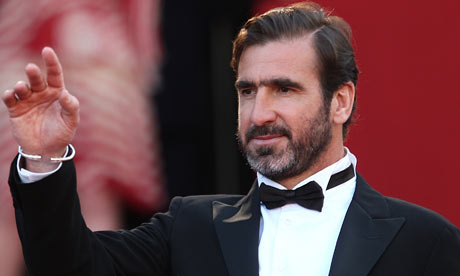
Eric Cantona, pictured here at Cannes, more recently popped up at Bath City FC. Photograph: Dominic Lipinski/PA

Eric Cantona pulled a ticket out of the black-and-white striped barrel, held up the number and waited patiently for the winner to come forward before handing over third prize, a bottle of white wine. The Frenchman had already spent more than three hours at Twerton Park speaking to the local media, mingling with a number of Bath City's part-time players and holding court in the non-League club's bar. Now he was drawing the raffle.

What was going through his mind when he was asked to dip into the "golden chest" at the same time as a voluptuous assistant approached is anyone's guess, though the smile that crept across his face as laughter broke out all around suggested nothing had been lost in translation. It was a comical moment at the end of a surreal afternoon when Cantona proved to be every bit as entertaining with a microphone in his hand as he once was with a ball at his feet.

He had spent the past week making appearances up and down the country in the lead-up to Friday's release of Looking for Eric – the Ken Loach-directed film in which Cantona plays himself – but this was an entirely different gig. Twerton Park was not so much the last stop on the promotional tour, but more an opportunity for Loach to give those connected with the club he has followed since 1974 a day they would cherish for the rest of their lives.

Randall's bar is where Bath fans will mull over performances in the Blue Square South league next season, but eight days ago it provided the venue for a question and answer session with one of the greatest players ever to have pulled on a Manchester United shirt. The ­humble surroundings must have seemed a million miles away from Old Trafford and the Cannes film festival, where ­Cantona graced the red carpet a few weeks ago, yet the 43-year-old appeared totally at ease.

No subject was off-limits and as ­Cantona sat for the best part of an hour, without once looking at his watch, ­candidly discussing everything from the part his father played in his infamous kung‑fu kick at Selhurst Park to his ambition of managing Manchester United and the exorbitant ticket prices that have ­hammered a nail into the coffin of the working-class supporter, it was tempting to wonder how Cristiano Ronaldo would handle a similar engagement.

After all, at the Football Writers' Association's annual dinner 13 months ago, Ronaldo demanded at the last minute that space was made for five of his entourage to sit on the top table with him. ­Cantona, in contrast, walked around Twerton Park with the minimum of fuss and took his seat on the small stage in front of the 350 supporters that had crammed into Bath City's function room as if he was pulling up a chair at home.

The first exchange, which followed a rapturous welcome, wonderfully set the tone for the next 60 minutes. Why do you think so many people are here and that you are still so popular, Eric? There was a brief pause before Cantona looked up and replied: "Because I am not a man. I am Cantona." The line was straight out of Looking for Eric and engendered the sort of reaction that used to be reserved for one of his exquisite touches at Old Trafford.

It also became clear there was more where that came from. What's the most difficult: playing football or acting in films? "For me," said Cantona, with a shrug of the shoulders, "everything is easy." For the second time in 60 ­seconds the room erupted and it was easy to ­imagine that if Cantona had got up from his seat and left at that point, no one would have complained that the £20 they had spent on a ticket did not represent value for money.

Cantona has always been box-office material. In his six seasons in English football, he won the league title on five occasions, four times with Manchester United and once with Leeds. He would probably have completed a clean sweep but for a notorious January evening in 1995, when Matthew Simmons, a 20-year-old Crystal Palace fan, provoked a furious reaction from Cantona that led to an assault charge, 120 hours' community service, a nine-month ban and Blackburn winning the league.

It was the sort of incident that ­Cantona could have been forgiven for side­stepping. Did you hear him or see him? "I heard him and I saw him," said Cantona, smiling. "And he heard me and he saw me!" Why did you decide to kick him? "My father, when I was young, he said: 'If you fight somebody one day, you have to kick them first'." Cue more mirth. "I could have killed him," continued ­Cantona. "I was nice to him really."

The quotation that Cantona later gave at Croydon magistrates' court – "When the seagulls follow the trawler, it is because they think sardines will be thrown into the sea" – is almost as ­memorable as the incident itself, though he insists that he never intended to cause such a stir. "It was a way for me to put a mirror in front of them [the journalists] and to try to make them realise that it was not so serious," he explained. "But all of them tried to analyse it."

Cantona returned from his suspension in October, when he scored against Liverpool, a feat that he repeated against the same opponents in the FA Cup final to help United win their second Double in three season. He was 29 years old and at the peak of his footballing powers, but 12 months later he quit. "I lost the passion for the game," he said. "I don't know why the passion went. You are in love with somebody and sometimes you break up."

He insists he has never regretted the decision. "I think the best years for a footballer are between 26 and 30 and I spent these years with United. I was lucky to spend these best years with the best club in the world, with the best players and with the best manager. The players were the kind of footballers that I dreamed about when I was a child. And it was the perfect football for a player like me. They gave me everything and I had a great time."

With acting now his priority, Cantona no longer follows football closely but he knows enough about the game to realise that much has changed since he retired and not necessarily for the better. One of the subjects he feels most ­passionate about is the soaring cost of tickets, an issue that Loach tackles in Looking for Eric through Cantona's co-star, Steve Evets, who plays Eric Bishop, a postman who has switched his allegiances from Manchester United to FC United, the club formed by fans disillusioned with the Glazer's takeover at Old Trafford.

Cantona, who had a working-class upbringing, empathises with those supporters who can no longer afford to attend top-flight matches and there seems little doubt that United's ­owners were uppermost in his mind when he suggested that football has betrayed its traditional fan base in the pursuit of wider profit margins. "There are many games on TV now and many sponsors come," said Cantona. "They [the clubs] make a lot of money.

"It's big business and because of that businessmen now own the clubs. If football was not so much on TV, I'm not sure these kind of men would be involved. So I am not so surprised with these kind of businessmen that the ticket prices are higher and higher. They don't care about working-class people. I try to understand it because I care. I came from this class. The real fans of football are the people I really love and these kind of people ­cannot go to the game anymore."

Not for the first time the silence that accompanied Cantona picking up the microphone was followed by cheering and applause when he put it down, and there was no sense that he was merely saying what the audience wanted to hear when he added: "I think it's a shame that the money the TV pays for football is spent on the clubs at the highest level. More money should be spent on clubs like this because Bath are the future."

Cantona's own future seems more difficult to plot. He is enjoying his new career as an actor, which he first became interested in when he was banned from playing, but there is also a feeling that he has some unfinished business in football. "If I come back, I try to come back for United," said Cantona. "I'm not sure that after a while [Malcolm] Glazer will ask me to become a manager. But I would love to. I don't care about what they [the Glazers] are saying."

While the chances of Cantona ­taking over when ­Ferguson retires appear slim, it is safe to say that there would not be a more popular appointment. His name continues to reverberate around Old Trafford 12 years after he played his last game for the club and his thoughts on his former manager's behaviour in the dressing room suggest that his current work could be more helpful than some people might imagine.

"I think managers are like actors," said Cantona when asked whether he had ever been on the receiving end of Ferguson's "hairdryer" treatment. "They do what the players need. They launch out because the players need to feel that. And [Ferguson] was a wonderful actor. Sometimes we needed confidence and he was quiet. Sometimes we needed him to be strong and he was. Every time he was right and that's why he is so successful."

While Cantona retains a great deal of respect for Ferguson, there is a former team-mate at Old Trafford whom he also holds in high esteem. "Ryan Giggs is 35 but still has the passion for the game. I admire this kind of player. I don't admire every player in the world who plays football until 35 years old because some of them play and are not passionate anymore. But when you see Giggs, every­body knows that he still has the fight and ­passion for the game."

The Q&A was drawing to a close and there was little Cantona had not covered. He had claimed that "no one could pay it" when asked what he would be worth in today's transfer market and he even offered an explanation for his famous upturned shirt collar. "One day I just put the shirt on and the ­collar did this," he said, gesturing to the audience. "I scored a goal and after it was like a habit. Sometimes a player keeps his underwear the same; I like to change mine."

With lines like that, it is ­little wonder that Loach enjoyed working with ­Cantona so much on set. The film director thanked the Frenchman afterwards and another standing ovation for King Eric ­followed. Bath City were around £12,000 richer and Randall's would never feel the same again. Cantona, however, was not quite finished. Moments later he was holding aloft a pink ticket with No62 on it. The bottle of wine must have tasted fantastic.

Sunday, April 26, 2009

My part in Cantona's film about United love


Source: The Observer

Ed; PDF version of the page (The Observer - 2009-04-26 - page 24)

* Tony Howard
* The Observer, Sunday 26 April 2009

For a diehard Manchester United fan it was a chance that was too good to miss: an offer to appear as an extra in a Ken Loach movie with Eric Cantona. Tony Howard recalls the dashed hopes and subterfuge that led to his date with destiny.

The text was intriguing: "Fancy being in a Ken Loach film? They're casting at the match on Wednesday night. Don't tell anyone for now."

Although I was a fan of Loach, I wasn't enthralled by the prospect of wasting time when there was a pint to be had before FC United of Manchester (the club formed by fans in the aftermath of the takeover of Manchester United by the American Glazer family) played a crucial game in March 2008 in their quest for a third successive promotion.

I rang the texter for more details and, by the time I put the phone down, I'd already planned my early getaway from work to be there on time, even if it meant being fired. The reason? The film was set to star one Eric Cantona, a man I'd spent my adult life idolising. A man who gave us memories to cherish and a great joy that is impossible to explain to anyone who is not a Manchester United fan. A man who represents what football was before it got taken away from us. The last great hero in red.

Loach and Cantona had got their heads together to create a film and they'd be using United fans as extras. I'd do anything, almost, to be a part of it.

Much to our disappointment, neither Eric nor Ken was there for the "casting", which entailed standing in a room at Gigg Lane, the home of League 2 side Bury, while a production assistant stuck a camera in your face. It was hardlyHollywood. But that was partly the point.

Loach had contacted FC United the previous autumn after Cantona and scriptwriter Paul Laverty had hatched an idea for a film involving Cantona appearing in a vision to a United fan whose life was falling apart. The main character had been priced out of going to the match with his mates and, as a vocal supporter of fan-owned football clubs, Loach had been impressed with the work FC United had done to make football affordable and to bring fans back together.

Both Loach and Cantona had stated their wish for United fans to feature as extras in Looking for Eric. Cantona wanted to say thanks to the supporters - those attending FC United, those still going to Old Trafford and those doing neither but still harbouring the same deep love for their football club, usually via a bar stool.

"We are a breed of memories," he once said. "That is why I have this love of Manchester and Manchester United. I am not on the pitch any more but I am still proud of that relationship. My feelings will always be in my heart." This was his homecoming. Any Red worth his or her salt had to be a part of it.

The proof of this love was evident in the build-up to filming. "I've just seen Eric in Sainsbury's on Oxford Road," was one more believable text; others were plain daft. "Sure, I've just seen Cantona downing a pint while stood on a table outside Sinclairs" seemed a bit less plausible.

His mere presence had resulted in a real buzz about the film before a scene had been shot. As expectations grew, the production company still hadn't contacted many of us. It was like waiting to hear the verdict after an interview for your dream job. Questions flew through my head. Was I too small? Was I too young? Did I not look hard enough?

Doubts grew as some mates started hearing back. They were given instructions on where to go and what to wear. My housemate was one of the lucky few: he rose bright and early on the Monday morning. He and several other friends had been told to wear dark clothes with no logos and to take either an FC United or Manchester United shirt to the meeting point. He came home that night with a broad grin across his face. He'd spent the day smashing up a house. Eric had turned up on set and posed for pictures with what seemed like the whole of Manchester. Except me. I was devastated.

The night after, he came home with a smile so wide his face was in danger of bursting. He'd spent the whole afternoon in a pub filming a scene featuring Eric. A day in the pub with Cantona - was he taking the piss?

That was it. "Put a word in for me, I've still not heard anything," was my desperate request. And he did, and I got a phone call telling me I'd receive a text on Thursday to film on Friday.

After days of heartache at missing out, I finally prepared to meet my idol. Except I didn't receive the promised text and looking at my phone well into the early hours didn't help. I was gutted - practically everyone I knew was going to be in the film and had met Eric. Maybe it just wasn't meant to be, I would never meet the one hero I had left in the world.

I phoned a mate on set on the Friday and she confirmed that filming hadn't started. "Sod it," I thought and jumped in a taxi, dressed smartly and clean shaven, as requested in the texts sent to everyone except me, and went to Salford University to bunk into the filming of a graduation scene.

The premise was that the main character's daughter was graduating and we were family members of another student. After we had been waiting around for hours, Loach appeared with his production crew and told us very little - as he often infamously does. Our instructions were to take pictures and clap a bit. We weren't really concentrating. Our minds were occupied with questions. Would Eric be in the scene? If not, would he be on set to say hello?

A painstaking afternoon was spent acting out the same scene, with forced smiles and aching hands from all the clapping. It was June, but as the sun fell in the sky and the night began to draw in, we were getting cold. And there was still no sign of the Frenchman.

There were plenty of false dawns. "That's him, he's there," was the day's second most common phrase, behind the hearty calls of "action!" During a break in filming, I and a mate, who was my "dad" for the day, gave chase after spying a recognisable figure sneaking behind the university building. We'd found a Cantona all right, but it was the wrong one. It was Eric's brother, Joel.

We'd begun to give up as filming drew to a close when my "dad" swore he'd finally spotted the right Cantona. This time he was correct and word spread quickly as the assembled extras made their way over to him for pictures. He posed and smiled for everyone before having to leave. I hadn't got near him. But there was always the "wrap party" that night.

The venue had been kept secret, but that didn't put us off. We'd get in by hook or by crook and finally meet our hero. I'd just added "bunking into a film set" to the CV, so a swanky bar in town would present few obstacles.

Only selected members of the crew had been invited, along with the small group of fans who had organised the extras. They were sworn to secrecy, but a phone call to a less than alert friend revealed the location.

"Hi, mate, you out tonight? Where are you?" I inquired.

"Loaf, on the locks," came the reply. All too easy.

We walked in as the bouncers were examining each other's shoes. I saw my housemate in the corner, deep in conversation with the man himself. Eric was casually sipping a Coke as he listened intently to my friend. We walked over, trying to act casual, and sat at the same table. They showed outtakes from the film on a big screen and Eric laughed with the rest of us, while looking over to fellow cast members and winking. It was surreal to be this close to a man you had spent so long admiring. I simply had to speak to him.

I'd been carrying a picture in my pocket all day that I wanted signing. It was crumpled and bent over at the edges, but it showed him in mid-flight, with the ball at his feet in his majestic pomp on the way to leading that young side to the double in 1996.

I couldn't drum up the courage to approach him, despite taking full advantage of the free bar. I'd never experienced this form of "stage fright" before. Through work I'd met members of the royal family, actors, television stars and even musicians I looked up to without being even slightly overawed. But with Eric it was different.

As my mate turned, I asked him what he'd been talking about. "Eric loves Manchester and what we're doing with FC and has promised to come to a game," was his excitable reply.

Then Eric got up to leave. Now had to be my moment or I'd regret it for the rest of my life. I leapt up and shook his hand as he went to pass. Stuck for anything to say and with my heart pumping I blurted out: "Thanks for everything, Eric. We owe you so much." It was one of the most cringe-worthy sentences I'd ever uttered.

"No, thank you. I owe you," was his reply. And with that he made his way through the throngs and out of the door.

Months later, at FC United's game yesterday against Bradford Park Avenue in the UniBond Premier League, 3,000 fans wore masks with Cantona's face on them as part of a publicity stunt from the film's production company. United fans sang his name, as they still do at Old Trafford. Thanks to this film, more than 10 years since he left our city, Manchester became Cantona's once more. And we were proper chuffed to have him around.

• Looking for Eric has been nominated for the Palme d'Or award at the Cannes film festival. It opens at cinemas in the UK on 12 June

Eric: from seagulls to kung fu

Born 24 May, 1966, in Marseille.

Status Somewhere between royalty and god. Manchester United fans refer to him as King Eric.

Career on the pitch Started with Auxerre in 1983, had spells with Bordeaux, Montpellier and Marseille. Joined Leeds in 1992, left for Manchester Utd the same year. Left the club when he retired in 1997 after scoring 64 league goals.

Career off the pitch Manages French beach soccer team. Fleeting appearance in the film Elizabeth

Character Fiery. Famously kung fu-kicked a Crystal Palace fan.

Outlook "When the seagulls follow the trawler, it's because they think sardines will be thrown in to the sea." . Also a tad romantic: "I'm so proud the fans still sing my name, but I fear tomorrow they will stop. I fear it because I love it. And everything you love, you fear you will lose."

Ed; PDF version of the page (The Observer - 2009-04-26 - page 24)

Sunday, May 20, 2007

Red Issue

Free Image HostingSource: The Observer Letters (no online content)

So Schalke ('145,000 see "German Newcastle" blow it', last week) are a club who have fans' interests at their heart, work closely with the community, price their tickets at an affordable level, refuse to pay the exorbitant amounts demanded by today's footballers and they still manage to compete at the top level in one of Europe's best leagues. Your piece followed nicely from the article the week before on how the greed and short-sightedness of the money-grabbing Premiership elite is damaging English football. Both should be photocopied and sent to every Glazer, Abramovich, Gillett, Lerner and Kroenke.

So what should fans do if they're fed up with clubs bleeding supporters dry? As Schalke's club secretary says, football 'isn't like a jeans shop where people can go somewhere else'. Fortunately I'm one of the lucky ones – I do have somewhere else to go: FC United of Manchester in the Unibond First.

Mike Birtwistle, via email